What Is a Decking Base and Why Does It Matter?
When planning a new deck, most people focus on the surface: the colour of the boards, the grain pattern, the finish. But the decking base, the structural frame underneath, is what determines whether your deck stays flat, safe, and solid for five years or fifty. A decking base (also called a subframe, foundation, or understructure) carries the entire weight of the deck, distributes loads, manages drainage, and resists everything the British weather throws at it. Get the base wrong and no premium board on top can save you from a sagging, rotting, rat-infested deck within a few years.
This guide compares the three main decking base materials available to UK homeowners: timber, aluminium, and galvanised steel. We will explain why the material you choose for your subframe is the single most important decision in any decking project, and why a growing number of homeowners are choosing steel over traditional timber.
Timber Decking Base: The Traditional Choice with Hidden Costs
For decades, treated softwood has been the default decking base material in the UK. It is familiar, widely available, and initially cheaper than alternatives. But the problems with timber subframes are well documented and, for many homeowners, painfully familiar.
Moisture movement: Timber absorbs water from rain, ground moisture, and humidity. As it absorbs water it expands; as it dries it contracts. Over two or three British winters, this constant movement loosens fixings, creates squeaks, and causes joists to twist. Once a timber frame starts moving, no amount of tightening screws will restore it to true.
Rot and decay: Even pressure-treated timber has a finite lifespan outdoors. The treatment slows decay but does not prevent it. Ground-contact timber, joists near soil level, and any area where moisture accumulates will eventually rot. The typical lifespan of a treated timber deck frame in the UK is 10 to 15 years before significant repair or replacement is needed.
Pest vulnerability: Timber is organic material that rats, mice, and wood-boring insects can damage. Enclosed joist bays create dark, sheltered nesting cavities. For a full explanation of why timber decking attracts pests, see our guide on why steel decking deters rats.
Maintenance burden: Timber frames need periodic inspection for rot, treatment with preservatives, and eventual partial or full replacement. This is not optional maintenance: it is structural necessity. Ignore it and your deck becomes unsafe.
Aluminium Decking Base: Lightweight but Limited
Aluminium subframes have gained some traction in the UK market, particularly for low-height decking on balconies and terraces. They share some advantages with steel: they do not rot, they are dimensionally stable, and they require no maintenance.
The limitations of aluminium are structural. Aluminium has approximately one-third the stiffness of steel, meaning aluminium joists must be larger and more closely spaced to carry the same load. This increases material cost and reduces the usable clearance underneath the deck. Aluminium is also more susceptible to galvanic corrosion when in contact with dissimilar metals, which complicates fixings and connections.
For most residential decking projects, aluminium is a capable material but not the strongest or most cost-effective option. Its niche is ultra-low-profile installations where every millimetre of height matters, such as balcony retrofits. For garden decking, a galvanised steel subframe provides greater strength at a comparable or lower cost.
Galvanised Steel Decking Base: The iFrame System
The iFrame galvanised steel subframe is the decking base we use at iGarden Vision for every installation. Here is why it outperforms both timber and aluminium across every measure that matters for UK gardens.
Engineered for strength and stability
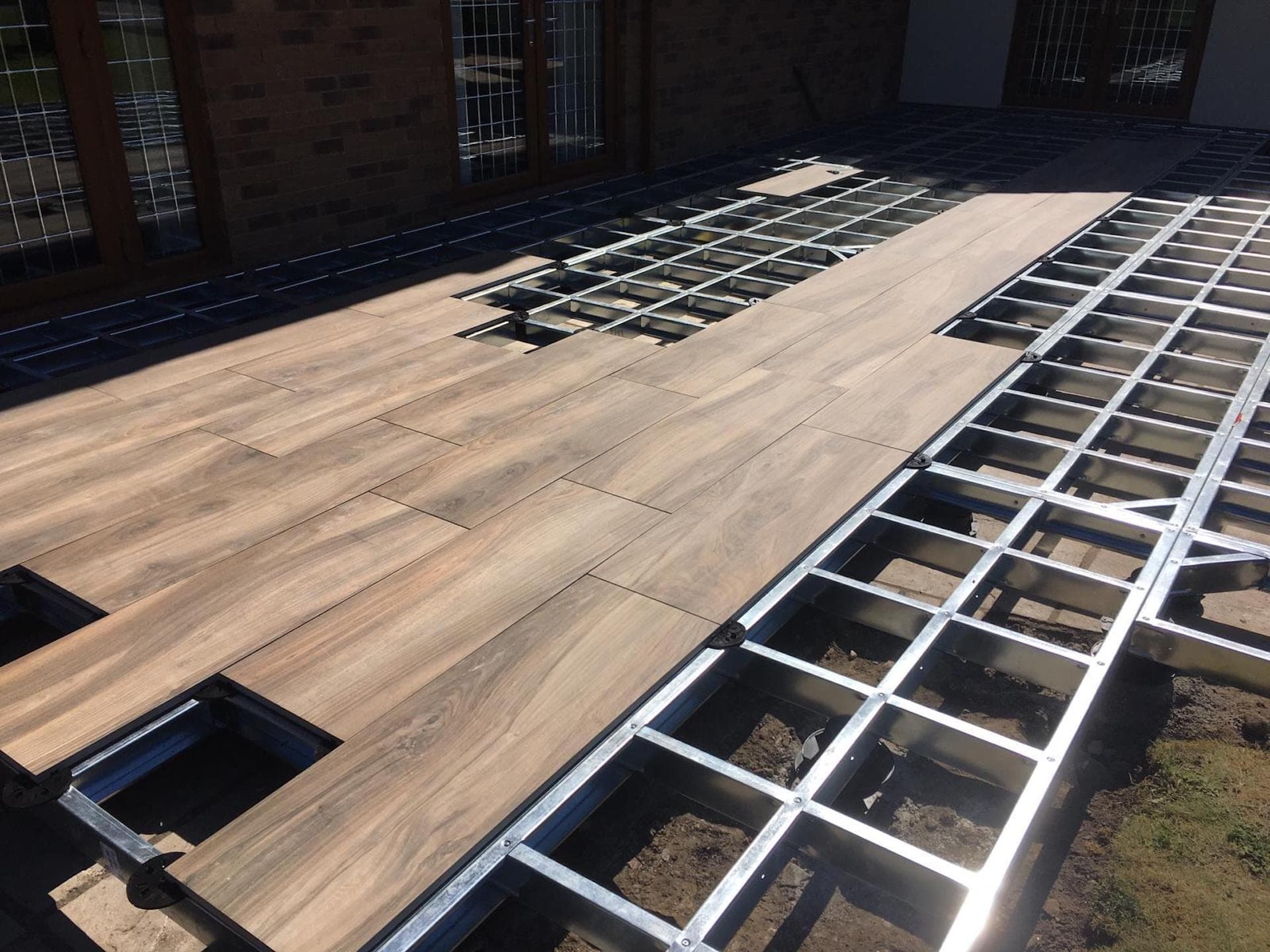
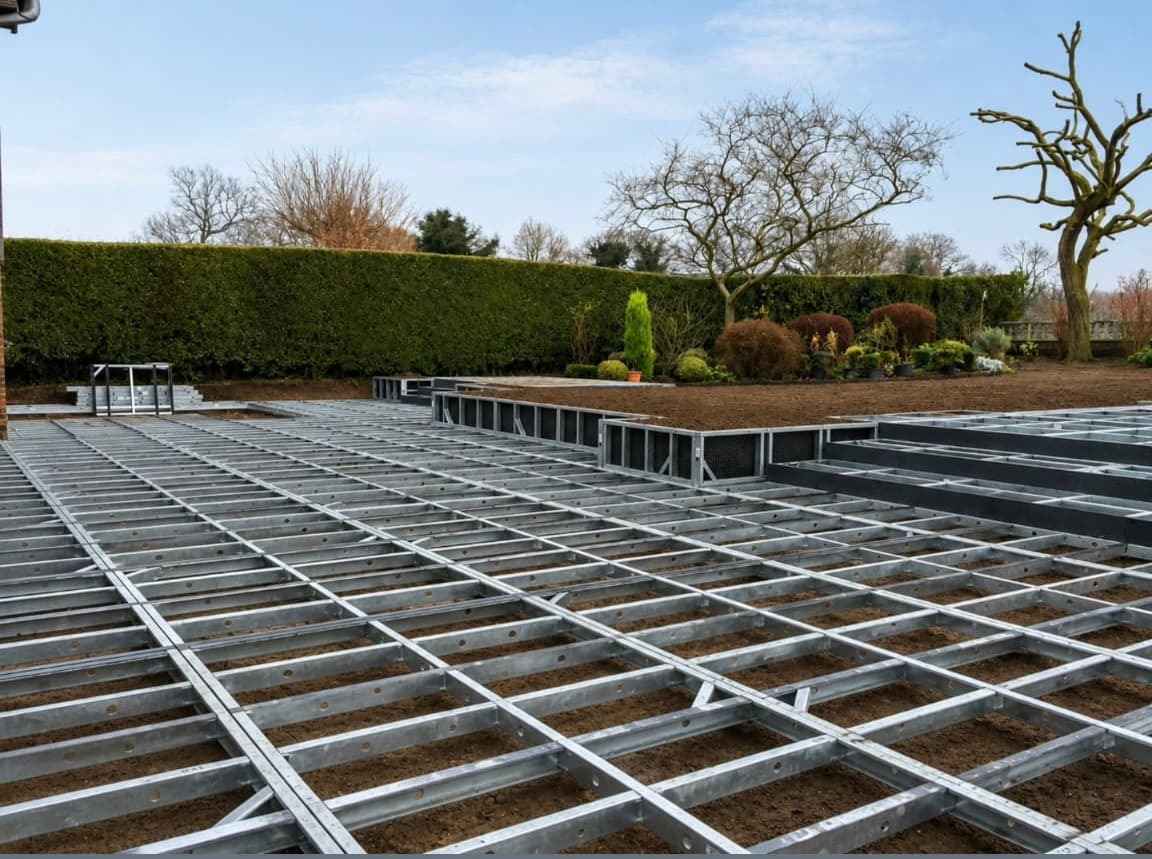
The iFrame is manufactured from cold-rolled galvanised steel, a material with exceptional strength-to-weight ratio and dimensional stability. Unlike timber, it does not absorb water, so it does not expand, contract, warp, or twist. The surface stays flat year after year with zero structural movement. Galvanised steel is approximately three times stiffer than aluminium, meaning the frame can span greater distances with fewer support points.
Adjustable for any ground condition
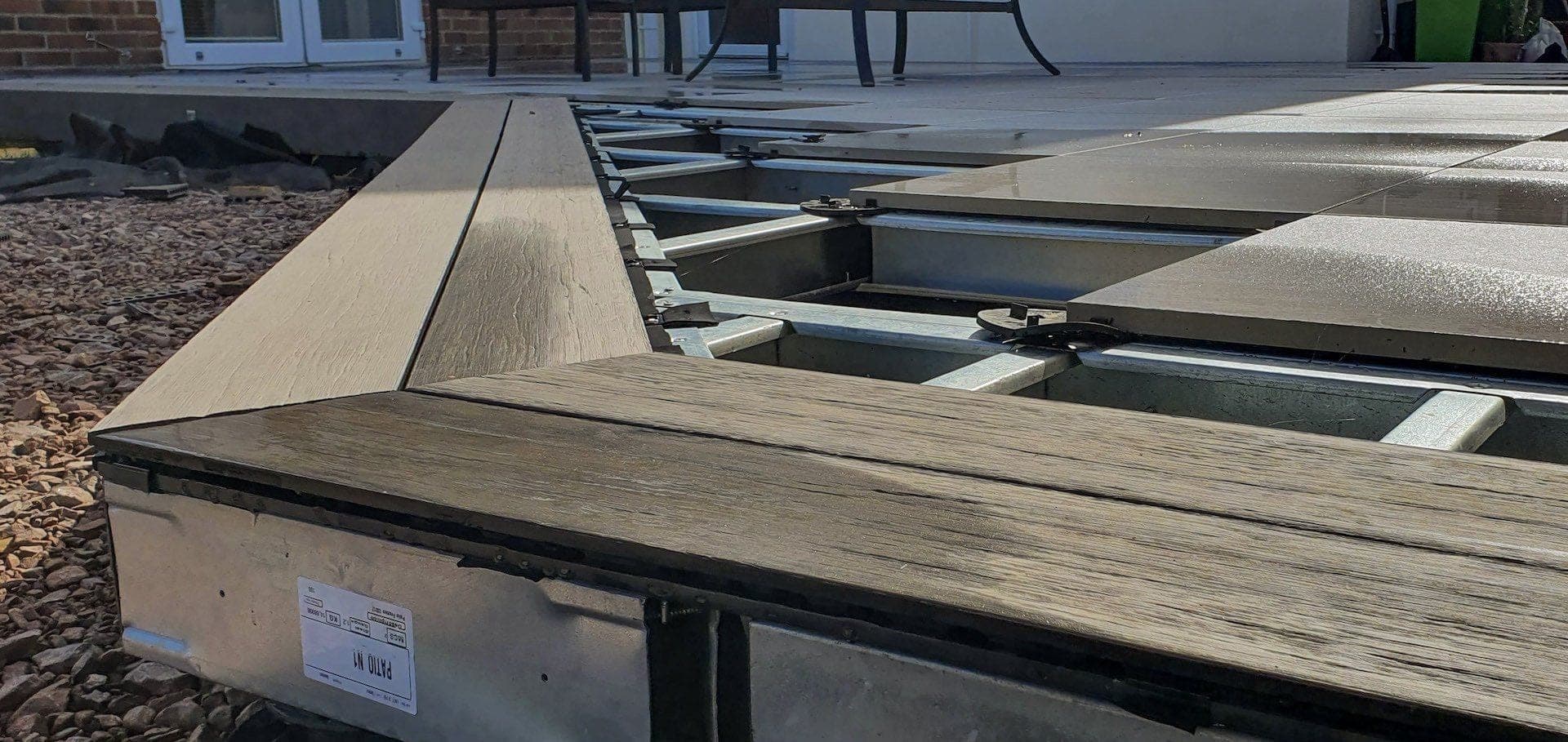
A traditional timber deck base requires a flat, level foundation: typically a concrete pad, compacted hardcore, or deep-set posts. This means excavation, spoil removal, and often skip hire. The iFrame takes a fundamentally different approach. It sits on adjustable steel pedestals placed directly on your existing ground. Each pedestal is independently height-adjustable, so the frame self-levels over slopes, uneven lawns, existing concrete, and even TPO-protected zones where excavation is prohibited.
There is no digging, no concrete pouring, and no wet trades of any kind. The entire installation is clean, fast, and leaves your garden's underlying surface undisturbed. For a full walkthrough of the installation process, see our step-by-step installation guide.
DPC-compliant and non-permanent
Because the iFrame is a free-standing structure with no fixings into the building, it is classified as non-permanent and does not typically require planning permission. The frame is engineered to sit 150mm below the damp proof course of any adjoining property, protecting your home from moisture ingress. Traditional patios and decking laid directly against the house wall frequently breach the DPC, causing damp problems that are expensive to remedy. Read our full DPC compliance guide for the technical detail.
50-plus year lifespan with zero maintenance
A galvanised steel subframe requires no treatment, no inspection, and no repair across its entire service life. The zinc coating protects the steel from corrosion for decades of outdoor exposure in the British climate. Compare this to a timber frame that needs treating every few years, inspecting annually for rot, and replacing entirely within 10 to 15 years. Over the lifetime of a garden, the total cost of ownership for steel is substantially lower than timber, despite the higher initial material cost.
Decking Base Comparison: Timber vs Aluminium vs Steel
Here is a direct comparison of the three decking base materials on the factors that determine real-world performance in UK gardens:
Timber subframe: Lowest initial cost. Absorbs moisture, expands and contracts, loosens fixings over time. Rots within 10 to 15 years. Provides nesting habitat for rats and insects. Requires annual inspection and periodic treatment. Creates enclosed, dark under-deck void.
Aluminium subframe: Mid-range cost. Does not rot or absorb moisture. One-third the stiffness of steel; requires closer joist spacing and larger sections. Susceptible to galvanic corrosion with certain fixings. Suitable for low-profile installations but not the strongest option for garden decking.
Galvanised steel subframe (iFrame): Higher initial material cost but lowest total cost of ownership over 25-plus years. Does not absorb moisture, warp, rot, or degrade. Three times stiffer than aluminium. Open pedestal design provides ventilation, drainage, and pest resistance. Adjustable over any ground condition. Zero structural maintenance for 50-plus years. Fully demountable and relocatable.
The choice of decking base is the most consequential decision you will make in your decking project. The surface boards can be replaced; the subframe is the permanent foundation. Choosing steel over timber means choosing a deck that stays flat, safe, and maintenance-free for decades rather than one that begins deteriorating the moment it is installed.
What Decking Surface Goes On Top?
Once your steel subframe is installed, you have two premium surface options, both supplied and installed by iGarden Vision:
Porcelain paving: 20mm outdoor porcelain tiles with R11 slip resistance. Frost-proof, stain-proof, and colour-fast. Available in natural stone, wood, and concrete effect finishes. A porcelain surface on a steel frame delivers a premium, architectural finish that outperforms both traditional paving and timber decking in every category.
Composite decking: Hollow (23mm) and solid (25mm) profile boards with a concealed clip fixing system. Available in multiple wood-effect colours. 25-year residential warranty. Composite boards on a steel frame provide the warmth of timber aesthetics without the maintenance, rot, or pest problems.
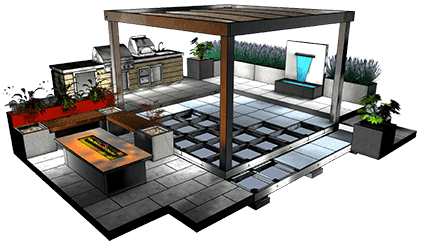
Both surfaces are fixed directly to the iFrame subframe. There is no additional base layer, no mortar bed, and no adhesives. The surface is the final layer on a fully engineered, fully adjustable steel foundation.
Is a Steel Decking Base Right for Your Project?
A galvanised steel decking base is the right choice if you want:
- A deck that stays perfectly flat for decades with zero structural movement
- An installation that does not require excavation, concrete, or wet trades
- A subframe that works over slopes, uneven ground, and TPO-protected zones
- A pest-resistant structure that does not provide nesting habitat for rats
- The lowest total cost of ownership over the life of your garden
Every iGarden Vision installation starts with the iFrame steel subframe. Whether you choose porcelain paving or composite decking for the surface, the foundation is the same: a precision-engineered, UK-manufactured galvanised steel frame built to your garden's exact dimensions. For a free, no-obligation consultation and quote, get started online or call us on 0333 577 1553.