Why Choose Metal Decking for Your Garden?
When most homeowners picture decking, they picture timber. But timber has a built-in expiry date: it rots, warps, splits and harbours algae, and the constant cycle of sanding, staining and replacing joists is a cost and a chore that never ends. Metal decking changes that. A steel or aluminium frame provides a stable, level platform that simply does not decay, and it does not need the deep foundations or concrete that traditional garden builds demand.
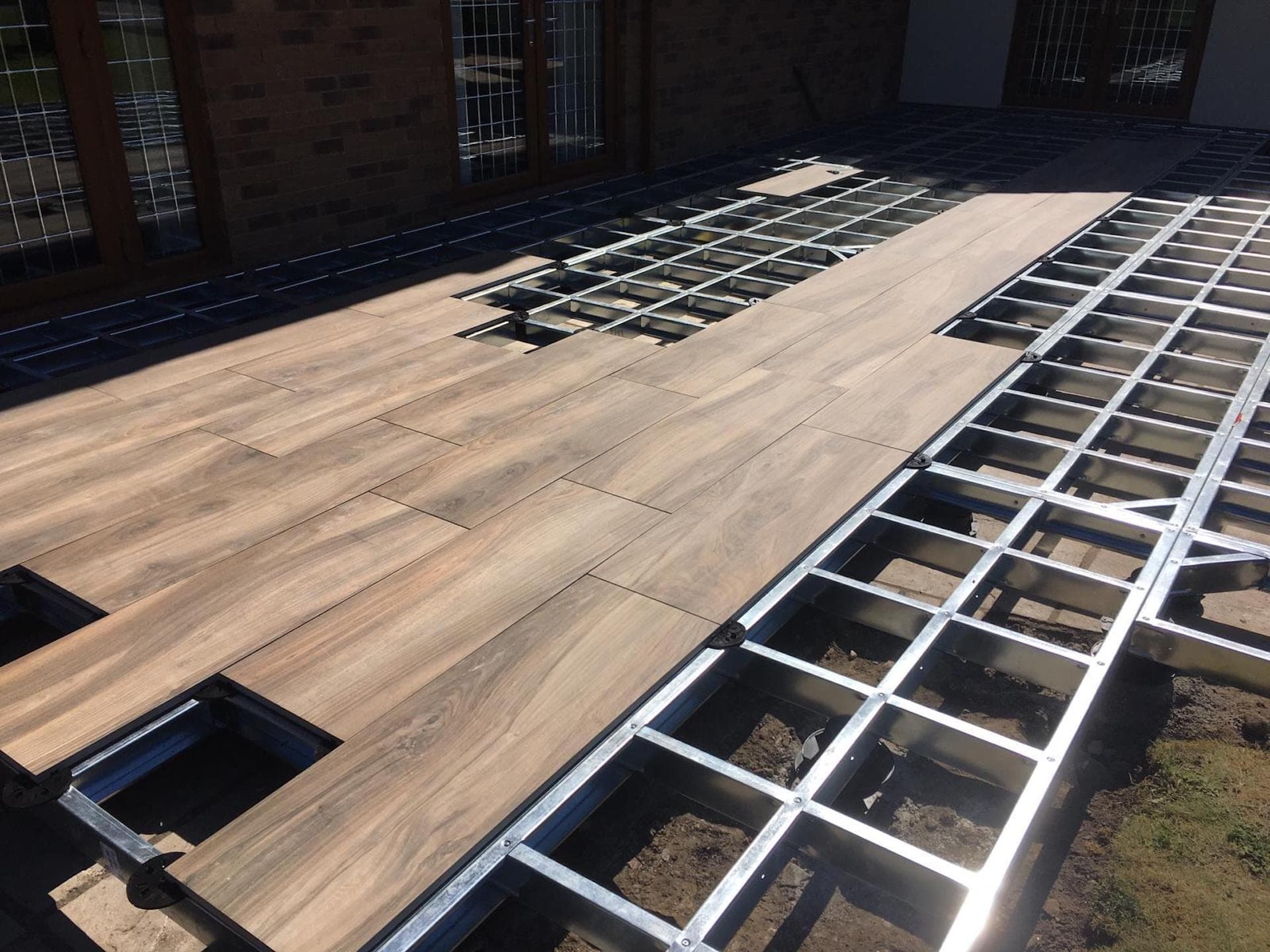
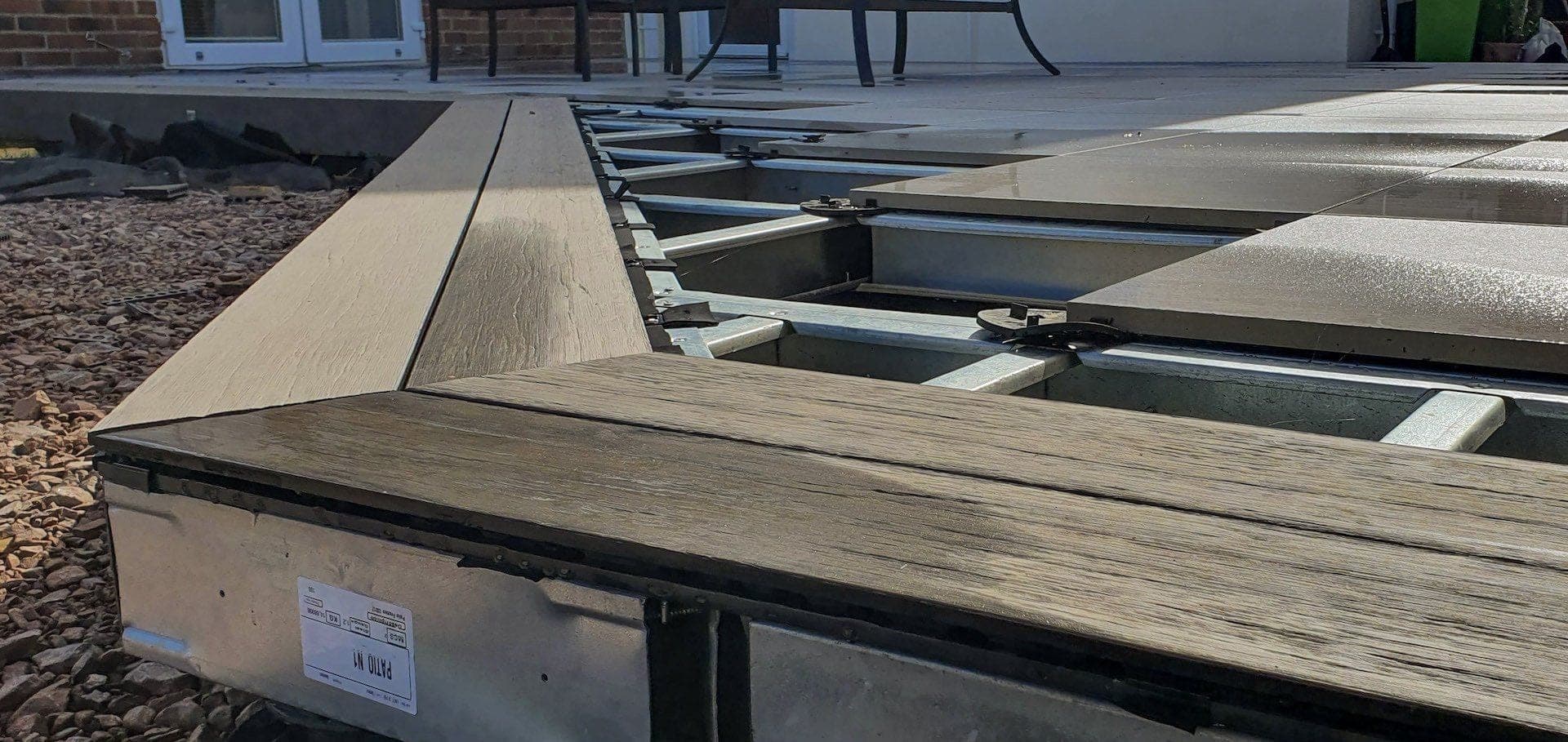
At iGarden Vision, every metal decking installation we complete uses the iFrame system: a cold-rolled galvanised steel subframe, precision-engineered in the UK and assembled on adjustable supports. It works over any ground condition, protects the building with correct DPC clearance, and can be removed and relocated if you ever move house. Here is everything you need to know before choosing a metal decking frame.
What Is Metal Decking?
Metal decking describes any decking structure built on a metal subframe rather than timber joists. The frame carries the walking surface, which is usually composite decking boards or porcelain paving, and transfers the load to the ground through adjustable support pads or pedestals.
Two metals dominate the market:
- Galvanised steel: cold-rolled steel with a protective zinc coating. Strong, dimensionally stable and corrosion-resistant, it is the structural metal of choice for commercial roofing and, increasingly, premium garden decking.
- Aluminium: lighter than steel and naturally resistant to corrosion, aluminium frames are easier to carry but generally more expensive per metre and less rigid over longer spans.
Because the frame does the structural work, the surface above it can be anything you like: composite decking boards for a classic deck look, or porcelain paving for a seamless indoor-outdoor finish.
Steel Decking vs Timber Decking: Which Is Better?
Timber remains the default choice because it is familiar and cheap to buy. The comparison changes when you account for the full lifetime of the structure.
- Lifespan: A timber subframe in contact with damp ground typically needs replacing within 10 to 15 years. A galvanised steel frame is designed to last for decades with no maintenance, and the composite boards it carries carry a 25-year residential warranty.
- Stability: Timber expands, contracts and twists as it dries, which is why deck boards work loose and squeak. Steel holds its shape, so the surface stays level and quiet for its whole life.
- Ground preparation: Timber subframes usually need concrete pads or posts set into the ground. The iFrame steel system sits on adjustable pedestals, so no excavation, no concrete and no digging is required.
- Rot and pests: Steel does not rot, does not warp and does not provide a home for wood-boring insects or the rats that nest under decaying timber joists.
For a deeper look at why the frame matters, read our comparison of steel subframes versus timber foundations and our guide to steel frame decking installation and costs.
Aluminium vs Steel: Which Metal Decking Frame Is Right for You?
Both metals outperform timber, but they suit different jobs.
Aluminium is roughly a third of the weight of steel, which makes it attractive for rooftop terraces and balconies where weight is a constraint. It is corrosion-resistant without coating, and it is the right answer where the frame must be carried up stairs or onto a flat roof.
Steel is stronger and stiffer, which means longer spans, fewer supports and a more rigid platform underfoot. The galvanised zinc coating protects it from rust for decades, and because the frame is manufactured to measure, there is no on-site cutting and no wasted material. For ground-level gardens, patios and decked areas up to full garden scale, a galvanised steel frame is the more robust choice.
Is Metal Decking More Expensive Than Timber?
Upfront, a metal subframe costs more than a bag of treated timber joists. Over the life of the deck, the picture reverses. Timber needs replacement joists, new boards, stains and sealants, and labour for every repair. A galvanised steel frame stays true, which means the surface above it stays level and quiet, and the only recurring cost is washing it down.
Because the iFrame system is manufactured to the exact dimensions of your garden, there is no over-ordering and no offcut waste. The adjustable supports mean the frame is installed in days rather than weeks, saving labour time on site. The best way to compare the numbers for your own project is to get a free personalised quote through the 60-second quiz.
How Is a Metal Decking Frame Installed?
The iFrame installation process is designed to be fast and clean, with no digging and no concrete:
- Design: We survey your garden, including a point cloud laser survey that maps the space to within 2mm, and engineer a frame to your exact dimensions.
- Manufacture: The galvanised steel frame is fabricated in the UK to your design, with adjustable legs pre-fitted.
- Assembly: The frame is carried in and assembled on its adjustable pedestals, levelled to millimetre accuracy over whatever ground lies beneath.
- Surface: Composite boards or porcelain tiles are laid on the frame, and the project is completed in three to five days on site.
Because the frame is a free-standing structure, it does not attach to your house wall. It sits 150mm below the damp proof course, protecting your property from moisture, and it counts as a non-permanent structure, which keeps planning permission simple in most cases. See the full sequence on our installation process page.
Can Metal Decking Handle Slopes and Challenging Ground?
This is where a steel subframe earns its keep. Traditional patios and decks on sloping gardens need excavation, retaining walls and levels of concrete. The iFrame system works the other way: its adjustable legs extend and retract to create a perfectly level platform above any ground.
That makes it the practical answer for gardens traditional landscapers walk away from: steep slopes, uneven lawns, heavy clay, and tree root protection zones where excavation is prohibited. Because the frame touches the ground only at its support pads, it is also fully demountable, so the structure can be lifted out and relocated without leaving a trace.
What Surface Goes on Top of a Metal Decking Frame?
A metal subframe is a platform, and the surface you choose sets the look:
- Composite decking: 23mm or 25mm boards with a natural timber appearance, zero splinters and a 25-year residential warranty. Ideal for a warm, classic deck.
- Porcelain paving: 20mm tiles with an R11 slip rating, available in large-format slabs for a clean, contemporary look that continues indoors.
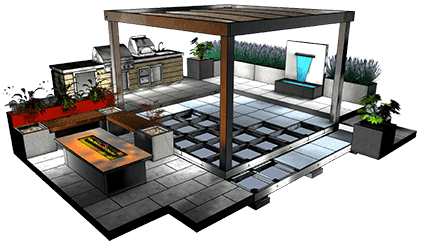
- Mixed layouts: Combine both, or add planters, lighting and water features, because the frame carries the load for all of them.
Whatever you choose, the result is a level, solid surface that sits at exactly the height you want, even over ground that would defeat a conventional build.
Is Metal Decking Maintenance-Free?
No outdoor structure is literally maintenance-free, but metal decking comes close. The galvanised frame needs nothing: the zinc coating protects the steel, and because nothing is buried in the ground, there is nothing to rot. The surface above it, whether composite or porcelain, is cleaned with soap and water and does not need staining, sealing, sanding or treating.
Compare that with a timber deck, which should be cleaned, sanded and re-stained every year or two, with joists checked for rot and boards replaced as they split. The time and money saved on upkeep is one of the main reasons homeowners choose a steel frame in the first place.
Is Metal Decking Right for Your Garden Project?
Metal decking suits almost any garden, but it shines where the ground is difficult, where the homeowner wants a genuinely low-maintenance space, or where the project sits on a slope, over a drain cover, or in a tree protection zone. It is also the obvious choice for anyone replacing a rotting timber deck for the last time.
If you are planning a new patio or deck, tell us about your project through the free quote quiz and we will show you exactly what a steel frame metal decking system would look like on your space. You can also call us on 0333 577 1553, or visit our showroom at the NSBRC in Swindon to see the iFrame system in person.